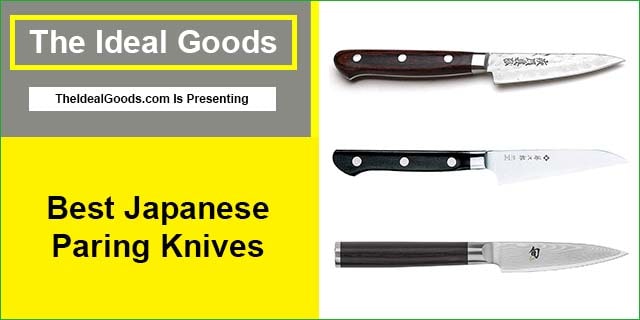
Read this well-researched article if you don’t want to buy fake Japanese paring knives that are made from cheap, low-quality steel or Chinese steel. All the knives I have selected here are from well-known manufacturers who have a long history of providing the highest level of satisfaction to hundreds of customers. Most importantly, every paring knife recommended here has been reviewed through use and testing.
I looked into 30-40 knives while compiling this list of original Japanese paring knives, and then I chose these knives based on a set of criteria. Here are some of the key criteria-
- Genuine Japanese steel of the highest quality is used to make each knife.
- Each knife has a full tang and is perfectly balanced.
- The handle is non-slip, ergonomic, and comfortable to hold.
- Of course, each knife is backed by a strong lifetime warranty.
Best Japanese Paring Knife – Top List
Best Japanese Paring Knife
1. IMARKU 3.5-Inch Japanese High-Carbon Stainless Steel Paring Knife
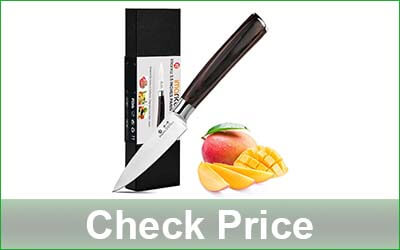
I received my paring knife two days ahead of schedule in excellent condition, packaged in a felt-lined presentation box with a magnetic closure. Inside, I found the shining paring knife along with a small plastic tip guard.
Blade Quality & Craftsmanship: The 3.5-inch blade uses forged Japanese high-carbon stainless steel with a hand-polished finish. High-temperature forging brings it to 58 HRC. Its plain edge features a 9°-15° angle per side and arrived razor-sharp, fully ready for immediate use.
Real-World Performance Testing: Over several weeks, I tested this knife daily. I sliced raw chicken breast into thin strips using short slicing strokes. I peeled potatoes and carrots with a circular paring motion, producing smooth, even strips in a single pass. I also sliced tomatoes into thin, even pieces and diced onions with a gentle rocking motion.
The knife trimmed fat from beef with good precision. It also cut through pineapple sections cleanly and handled cantaloupe slices without tearing the fruit. For smaller tasks, I minced garlic and chopped fresh herbs by anchoring the tip on the board and rocking the blade through each clove and leaf.
Edge Retention: After about two months of near daily use, the edge stayed sharp without needing a single touch up.
Handle & Ergonomics: The Pakkawood handle has a rounded profile with a smooth finish and a full tang construction secured by a polished bolster. At under three ounces, the knife feels light yet balanced, with the weight distributed evenly between the blade and handle, giving me excellent control during peeling and detail work.
Its standard size fit naturally in my large hand, and the surface remained secure even when slightly damp. Even during extended prep sessions, I experienced very little hand fatigue.
The Storage: There is no sheath included, only a small plastic tip guard that covers less than half an inch of the blade. However, the knife stores well inside the felt-lined presentation box.
Maintenance & Care Routine: I hand wash the knife with warm soapy water and dry it immediately with a towel. I never place it in a dishwasher. For maintenance, I use a 1000-2000 grit whetstone at roughly 9°-15° per side and hone regularly with a steel rod. I store it in the presentation box and avoid cutting on hard surfaces.
Pros
- Razor sharp straight out of the box
- Excellent precision for detail work
- Strong edge retention performance
- Comfortable ergonomic Pakkawood handle
- Well-balanced for controlled cutting
- Premium gift-ready presentation box
- Versatile for fruits and vegetables
- Backed by a lifetime warranty
- Top-notch knives at a low price
Cons
- No real blade sheath included
- Tip guard offers limited coverage
- Handle splitting reported by some users
- Slightly light for some users
- Minor blade discoloration is possible
2. HOSHANHO 3.75-Inch 10Cr15CoMoV High Carbon Stainless Steel Japanese Paring Knife
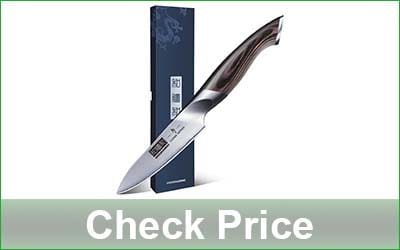
It arrived in a gift-worthy navy blue box with protective packaging, two days early, undamaged. Upon unboxing, my first impression was a beautiful hand-forged look that shows pride in craftsmanship. The knife is extremely sharp and ready to use.
Blade: The 3.75″ blade is made from Japanese 10Cr15CoMoV high-carbon stainless steel with a hardness of up to 60 HRC, and it comes hand-sharpened to a razor-sharp 15-degree edge right out of the box.
Cutting Performance: I’ve tested it for peeling apples, sweet potatoes, avocados, and other veggies, and it handles everyday kitchen prep with ease. The knife slices kiwis, lemons, mangoes, strawberries, and papayas with almost no effort. The optimal length makes it easy to hold, giving excellent control and precision for delicate fruit work. The knife feels lightweight and nimble in my hand, perfect for detailed prep, and holds its edge longer than expected.
Handle: The natural pakkawood handle feels smooth, sturdy, and warm in the hand. It offers a comfortable, ergonomic grip designed for fruit prep. The full tang construction, with a stylish metal bolster and end cap, adds balance and durability. There are no gaps or uneven edges, and even after a few drops, it showed no cracks or shrinkage. It fits my large hand well and stays secure, even when wet.
Maintenance: Not dishwasher safe. Hand wash and dry immediately. Leaving it wet may cause rust spots. Store dry. Use a 1000/4000 grit whetstone at a 15-degree angle for best results.
Pros
- Arrived surprisingly sharp, ready to use
- Holds edge well after months of use
- Perfect for precise fruit prep tasks
- Pakkawood handle feels comfortable and secure
- Excellent ergonomics, feels optimal in the hand
- Well-balanced, nimble, not too heavy
- Designed for comfortable palm grip cutting
- Great craftsmanship, feels premium for the price
- Excellent value, worth every dollar
Cons
- Requires careful maintenance after every wash
- Rust develops when it is left wet briefly
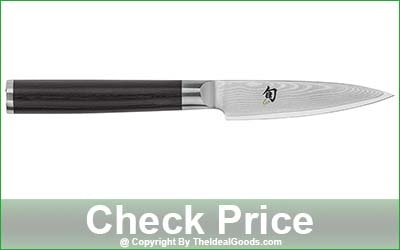
3. Shun Cutlery Classic 3.5-Inch VG-MAX Super Steel 68 Layers Japanese Paring Knife
If you’re a serious home cook or a professional chef looking for a pure Japanese peeling knife that’s masterfully designed and crafted in traditional Japanese style, who better than Shun?
Blade: The 3.5″ blade is made from 69 layers of Damascus steel. At its core is premium Japanese VG-MAX steel (HRC 60–61), wrapped with 34 layers of soft high-carbon stainless steel on each side, totaling 68 outer layers.
I’ve used this Japanese steel paring knife to cut a variety of foods effortlessly – peeling and slicing fruits and vegetables, trimming meats, and creating intricate garnishes. Its balance, overall 8″ length, and exceptional performance make it highly agile for delicate dicing tasks.
The Damascus cladding gives the blade a unique, distinctive look. Thanks to the layered construction, food doesn’t tear or stick easily during cutting.
Handle: The Pakkawood handle is well-shaped and moisture-resistant. Its classy D-shaped design is ergonomic and comfortable to hold. The wood feels warm, grippy, aesthetically pleasing, and easy to control.
Additionally, the smooth, rounded choil allows me to rest my index finger comfortably, providing excellent control, precision, and added safety while cutting.
The Shun Classic Japanese paring knife feels slightly heavier, but the full-tang construction, polished bolster, and end cap make it noticeably sturdier and better balanced.
Pros
- Razor sharp right out box
- Thin blade slices with precision
- Edge retention impressed me greatly
- Fits my large hands perfectly
- Moisture-resistant handle feels durable
- Handcrafted quality from Seki, Japan
- A lifetime warranty gives peace
Cons
- No sheath included in box
- Handle feels slightly too thin
4. SHAN ZU 3.75-Inch 9-Layer 10Cr15MoV High Carbon Steel Japanese Paring Knife
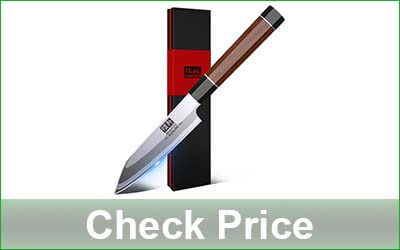
I received my order two days ahead of schedule. The knife arrived in an elegant gift box that immediately felt special. Inside, I found the paring knife securely packed and in flawless condition. The matte blade and wood handle gave it an upscale appearance right from the unboxing.
Blade Quality & Craftsmanship: The 3.75-inch blade uses a 9-layer forged construction with a Japanese 10Cr15CoMoV steel core, hardened to 62-64 HRC. Its matte finish, plain edge, and 15° sharpening angle arrived exceptionally sharp and ready for immediate use.
Real-World Performance Testing: After several weeks of use, I tested this knife on apples using controlled peeling strokes and on peaches with smooth slicing cuts that avoided bruising. I also sliced lemons into thin, even slices and cut ripe tomatoes cleanly without crushing them. For fish, I trimmed fillets and worked through sashimi cuts with light forward strokes, letting the edge do the work.
For smaller tasks, I used the fine tip to devein shrimp, hull berries, core apples, and mince garlic, where its accuracy and control stood out during detailed cutting tasks.
Edge Retention: After weeks of daily cutting through produce and fish, the edge stayed sharp without a single touch-up.
Handle & Ergonomics: The handle is crafted from red sandalwood in an octagonal shape and features a full-tang design that gives the knife excellent balance. At 6.7 ounces, it feels light and well-balanced in my big hand. Its shape naturally guided blade control during detail work, while the lightweight build reduced fatigue during longer prep sessions.
The eight-sided handle has a smooth, refined finish that feels comfortable in my grip without causing any irritation. Even when my hands were wet, I maintained a secure grip with no slipping.
The Storage: There’s no dedicated sheath included, but the knife can be stored safely in the provided gift box. The box protects the edge well during storage, although it doesn’t provide ventilation or moisture protection. I now keep the knife in a knife block, which protects the edge and helps keep moisture away.
Maintenance & Care Routine: I hand-wash it after each use and dry it promptly with a towel rather than using the dishwasher. I avoid bone and frozen food, sharpen on a whetstone from 1000 to 8000 grit at 15 degrees, hone weekly, and oil the handle.
Pros
- Excellent edge retention after weeks of use
- Comfortable, well-balanced sandalwood handle
- Full tang construction adds durability
- Lightweight design reduces hand fatigue
- Elegant gift box for presentation
- Matte finish resists fingerprints nicely
- Handles delicate tasks with precision
- Limited lifetime warranty coverage
- Premium knife at an affordable price
Cons
- No dedicated blade sheath included
- Hand washing is recommended over the dishwasher
- Handle needs occasional oil conditioning
- Extremely sharp requires careful handling
5. HOSHANHO 3.75-Inch 10Cr15CoMoV High Carbon Steel Core 9-Layer Japanese Paring Knife
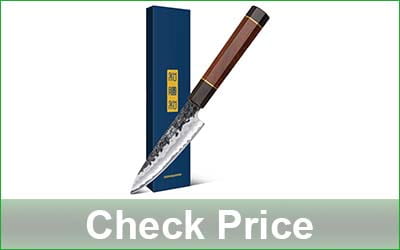
I received the knife one day early; it came in a sturdy navy blue gift-ready box. Be careful when removing it, it’s razor sharp. After opening and holding the Japanese peeling knife, my first impression was stunning and beautifully crafted.
Blade: The 3.75-inch blade is hand-forged from premium Japanese 10Cr15CoMoV high-carbon steel with a 9-layer laminated construction. It’s nitrogen-cooled, hardened to 60+ HRC, and sharpened to a precise 12–15° edge per side. Comparable to VG-10, it offers excellent sharpness and durability.
Cutting Performance: I started testing with fruit – peeling apples, oranges, and citrus, and slicing lemons and avocados – and it delivered precise, clean cuts in a single motion. I then finely minced garlic and onions for family dinners and cored tomatoes for fresh salads, all effortlessly smooth. I also used it for slicing and prepping meat and chicken breast. The pointed tip offers excellent control and maneuverability, making it ideal for coring and delicate garnishing. Even after two weeks of daily use, the blade holds its edge beautifully.
Handle: The handle combines G10 and rosewood in an octagonal shape, accented with two embedded copper wires that add a touch of luxury and elegance. Its full tang construction provides excellent balance, and the overall design looks clean and refined with no flaws I could find. It feels very comfortable in the hand, making blade control easy, and offers a secure grip even with wet or oily hands.
Maintenance: Hand wash only – do not use a dishwasher. Clean it after each use with mild soap, warm water, and a soft sponge, then dry immediately with a towel. As a high-carbon steel knife, it requires extra care, so store it in a knife block, on a magnetic strip, or in a blade guard. Avoid soaking the handle for long periods. I recommend sharpening on a whetstone every 2–4 weeks, depending on use, maintaining the 12–15° edge with a 1000–6000 grit Japanese whetstone.
Pros
- Tapered tip gives excellent control
- Effortlessly cuts fruits and vegetables
- Stays sharp after weeks of use
- Well-balanced feel with a very comfortable grip
- No wrist strain during extended prep
- Beautiful craftsmanship, feels truly premium
- Professional quality at an affordable price
Cons
- Slightly heavier than expected feel
6. Yoshihiro VG10 16 Layers 3.2-Inch Japanese Paring Knife
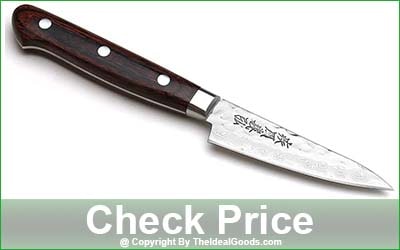
If you’re looking for an ultra-premium Japanese steel paring knife, who better than Yoshihiro?
Blade: The 3.2″ full tang blade is crafted from high-end Japanese 17-layer Damascus stainless steel. Its core is VG-10 super steel (HRC 60+), with 8 layers of stainless steel cladding on each side, totaling 16 layers.
The blade was scalpel-sharp right out of the box. Even after two months of daily use – mincing, peeling, trimming, and slicing fruits and vegetables – I was surprised by its edge retention; it remained as sharp as the day I received it.
The Japanese carbon steel pairing knife has a slightly wider belly and a gently curved tip, which naturally guided my hand while thinly slicing ingredients. Peeling and precision cutting felt completely effortless – almost a new experience.
Premium Japanese steel also allows for an instant razor-sharp edge when sharpened with a high-quality water stone.
Handle: The mahogany Western-style handle is comfortable to hold for extended periods, making delicate tasks easier. It feels smooth, non-slip, and ergonomic.
The fittings are flawless – no gaps or sharp edges between the wood, bolster, and triple rivets. Every joint is polished perfectly, with no uneven corners or surfaces.
The choil is well-sized and positioned at the ideal distance from the bolster, giving excellent control during delicate work. Even though the choil isn’t fully rounded, my index finger never felt fatigued or sore, and it prevents accidental slips onto the blade.
Pros
- Resists stains and rust extremely well
- Sharpens easily, holds edge beautifully
- Food rarely sticks to blade
- Dark handle and shiny blade stunning
- Feels balanced and controlled in hand
- Traditional Japanese craftsmanship truly shows
- Limited lifetime warranty adds confidence
- Premium knife worth every penny
Cons
- No protective sheath included
- Honestly, I found no real downsides
7. Dalstrong Shogun Series ELITE AUS-10V Super Steel 67 Layers 3.5-Inch Japanese Paring Knife
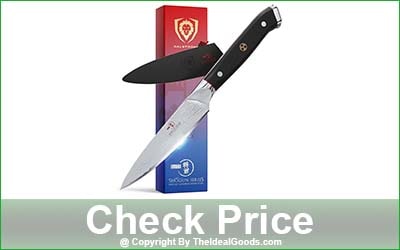
When someone asks me about professional kitchen cutlery that blends Japanese and Western styles, I always recommend trying Dalstrong knives.
Blade: This paring knife features a 3.5” long, 1.5mm thick 67-layer Damascus steel blade. Dalstrong uses premium Japanese AUS-10V steel (HRC 62+) for the core, folded with 33 layers on each side, totaling 66 layers of high-carbon stainless steel to protect and support the core.
The forged blade undergoes Dalstrong’s special nitrogen-cooling and precision vacuum treatment, enhancing durability, toughness, edge retention, and wear resistance far beyond normal conditions. The blade is so sharp it feels like cutting butter when slicing fruits and vegetables.
After using this knife almost daily for the first three months, the blade remained as sharp as day one, proving its superior steel quality. After about five months, it lost a little sharpness, but I restored the factory edge (8–12°) in just a few minutes on a whetstone.
Handle: The triple-riveted handle is made from military-grade G10, which is heat, moisture, and water-resistant, making it easy to maintain and very durable.
The full tang handle is perfectly sized, offering a comfortable, secure grip and a substantial, balanced feel. The scales, tang, rivets, bolster, and end-cap are all highly polished and smooth.
The Western-style handle is easy to hold and maneuver. With the blade and handle perfectly balanced, I didn’t feel any hand fatigue even during extended use.
Dalstrong provides a custom black plastic sheath for safe storage. It’s sturdy, well-made, and includes a small button to lock the knife in place, as well as a lanyard hole for hanging.
Pros
- Came razor sharp out box
- Resists rust, needs little maintenance
- Food rarely sticks while slicing
- Full tang feels solid and balanced
- Fits my XL hands perfectly
- Includes pin, sheath, cloth, instructions
- Lifetime warranty and refund guarantee
Cons
- No issues noticed so far
8. Zelite Infinity AUS-10 Super Steel 67 Layers 4-Inch Japanese Paring Knife
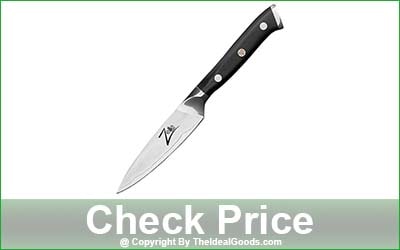
If you’re on a tight budget but want a high-quality Japanese-style kitchen knife, you should try the Zelite Infinity without hesitation.
Blade: The blade core is made from imported Japanese AUS-10 premium steel (HRC 60–61) and is protected by 33 layers of high-carbon stainless steel on each side, totaling 66 layers.
The 4″ blade is slightly thicker (2.4mm) than other Japanese paring knives I’ve used and comes super sharp from the factory. It slices through food with minimal resistance, making tasks like slicing, dicing, and peeling quick and effortless.
Because the blade is a bit longer and stronger, I’ve used it for vegetables, fruits, and even some tougher kitchen items. Edge retention is excellent, though occasional stropping is needed to maintain peak performance.
Handle: The rounded handle is made of black G-10. It fits perfectly in small to medium hands but may feel slightly small for larger hands like mine. The triple-riveted full tang handle, with a bolster and end cap, feels solid, substantial, and slightly weighty.
Despite the weight, the balance between the blade and handle remains excellent. The slightly curved handle allows comfortable use for extended periods, whether performing delicate or heavier tasks.
Pros
- Edge holds well, thanks to nitrogen tempering
- Resharpens quickly at fifteen degrees
- Damascus finish reduces food sticking
- Western handle feels natural in hand
- G10 grip feels secure and balanced
- Built sturdy for versatile kitchen tasks
- Worth every penny I spent
- Lifetime warranty adds buying confidence
Cons
- Handle slightly small for me
- No sheath, just elegant packaging
9. Tojiro DP 13-Chrome VG-10 Stainless Steel 3.5-Inch Japanese Paring Knife
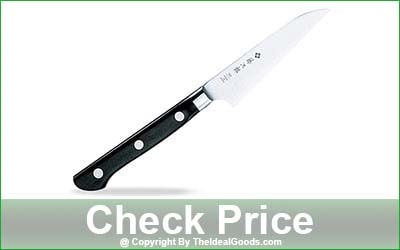
Tojiro DP is a well-known name in high-quality Japanese cutlery, though some people have raised concerns about aesthetics and craftsmanship.
Blade: The forged paring knife features a 3.5” blade made of Japanese VG-10 stainless steel (HRC 60.5). While not as thick as some other paring knives, it is sturdy and reliable.
Thanks to the flat profile, I had excellent control and accuracy even when cutting off the board. Peeling, mincing, dicing, coring, and delicate slicing of vegetables or fruits felt very easy – even for beginners.
The Japanese stainless steel paring knife arrived razor-sharp out of the box. After several months of use, the edge retention remained very good. The 13% cobalt alloy in the steel greatly enhances stain and corrosion resistance, so I don’t worry about washing it immediately after use.
Handle: The Micarta handle fits my large hands perfectly. While it may look a bit plain, the quality is excellent, and maintenance is minimal.
The handle’s fittings and finish are smooth and flawless, with no gaps, uneven surfaces, or sharp edges. The slightly rounded choil allows me to rest my index finger comfortably, enabling long periods of use without fatigue or discomfort.
The knife comes with a soft plastic cover, which serves as a short-term blade protector.
Pros
- Blends Japanese and Western knife styles
- Small chef knife slices precisely
- Straight blade sharpens very easily
- Full tang handle feels robust and balanced
- Single-piece construction ensures excellent durability
- Easy to maintain after regular use
- Lifetime warranty covers manufacturing defects
- Affordable price for a Japanese knife
Cons
- Handle fit and finish sometimes poor
- Blade shape limits versatile kitchen use
FAQs About the Best Japanese Paring Knife
Question: What is a Japanese paring knife?
Answer: The paring knives that are made from genuine Japanese steel are called Japanese paring knives. However, these knives may not be made by the Japanese or in a Japanese style or in Japan. The blades of these knives are usually 3 to 4 inches long, very sharp, and thin.
Question: What is a good Japanese knife brand?
Answer: The best Japanese brand for me is Yoshihiro. Because their knives are made by skilled craftsmen in Japan and maintain the highest quality. Besides, their knives are as luxurious to look at as they are comfortable and durable to use.
Question: How long does a Japanese paring knife last?
Answer: If you use a good quality Japanese paring knife regularly for light work and maintain it properly, you can use it for more than a decade. However, the knife may become unusable within five to ten years if it is regularly used in heavy work and not properly cared for.
Question: Can a Japanese paring knife be used for cutting meat?
Answer: Japanese paring knife is not suitable for cutting meat but can be used for cutting soft and thin boneless meat on occasional needs.
Question: What should you not cut with a Japanese paring knife?
Answer: You should not cut hard or frozen foods, bones, large or thick pieces of meat, dense or hard-skinned fruits (for example – nutshell, jackfruit, durian, watermelon, coconut, cherimoya), and vegetables (for example – butternut squash, pumpkin).
Question: Can Japanese steel rust?
Answer: Japanese steel knives, like any other steel, will definitely rust if not cared for properly. Japanese steels with a higher carbon content are more prone to rusting and these knives require a bit more care than stainless steel to keep them from rusting.
Question: How to care for a Japanese paring knife?
Answer: Compared to other steels, Japanese steel is very expensive and environmentally sensitive, so if you want to use it for a long time, it is very important to maintain it regularly in the right way. Follow the procedure given below for caring Japanese steel paring knife.
- Cleaning: Regardless of whether the knife is stainless steel or dishwasher safe, always hand wash after each use, except in the dishwasher, and dry quickly with a tissue or towel. Also, wash the knife immediately after cutting onions, lemons, oranges, citrus, or any other acidic foods.
- Cutting Board: Avoid cutting food on hard surfaces like glass, metal, ceramic, granite, and porcelain.
- Sharpening: Light stropping twice a month and sharpening every 3-6 months is essential if the knife is used regularly. Use premium or good-quality whetstone for sharpening. If you don’t have some skills, it is best to have these types of knives sharpened by a professional.
- Storing: Be sure to store in a dry place with an oil coating if not in use for a long time.
If you want to know in more detail, see this article – How To Care for Japanese Knives?
Question: How do I sharpen a Japanese paring knife?
Answer: Soak the sharpening stone in water thoroughly for 20 minutes. Then keep sweeping from heel to tip against the stone according to the edge angle of the blade (15-20 degrees).
Alternate the side of the blade after 5-10 strokes. Repeat the process until the blade is sufficiently sharpened. When the knife is perfectly sharp, wash and wipe it with a towel.
Since Japanese paring knives are very precious and fragile, the knife can be damaged if not properly sharpened. So if you are new to this job, I would advise you to get the knife sharpened by a professional.
If you want to know in more detail, see this article – How to Sharpen a Kitchen Knife with a Whetstone? or Best Ways To Sharpen Kitchen Knives at Home